Tuesday, September 29, 2015

Public transport in the age of the smartphone

Summary

Now that most people have smartphones, why do we need fixed timetables for public transport?

Detail

My wife and I visited Sydney a while ago. We haven't spent much time there and don't know the way around well. To navigate, we used Google Maps and selected public transport as our method. It is quite amazing -- Google is able to tell us where to walk, which bus/train/tram stop to wait at and it  even designs connections allowing time to walk between them. In my experience (and I now use it exclusively when planning a journey via public transport) its performance has been flawless.

It got me thinking -- 85% of Australian adults now own a Smart Phone. If we reach a situation where people can be relied on to have a smart phone, how can we take advantage of this to (re)design public transport?

Imagine

It's 2017, and you want to go somewhere by public transit. You use your smartphone to plan where and when you want to go (whether it is now or in 30 minutes' time). The app lodges the journey request with the local public transport authority (PTA), where there is a computer that dynamically generates the routes and timetables to minimise waiting times and maximise the directness of routes. The transport fleet is different -- there are still many large buses/trains/etc but in addition there are now a local fleet of small mini-buses (say 8 - 12 seats) that facilitate relatively local movements or act as feeders to the larger/faster routes.
The novelty of this idea is that the routes and timetables are dynamically generated -- there are no fixed routes or timetables -- these are designed on-the-fly in response to demand. There are New Years eve fireworks in Sydney and 1.5 million people want to go home at 1am? No problem -- feeder shuttle buses take people to the trains and larger buses take people to places where rail service is poor. Because the route planning is centralised, it can even avoid bus-jams (traffic jams comprised almost entirely of buses) by rerouting accordingly.

From the users' perspective, the service would operate similar to using Google Maps to plan a journey.
From the drivers' perspective, it would be like using a GPS navigator that tells them where to go and whom to collect/deposit.

Why?

Public transport is hugely under-utilised -- many buses/trains are well below capacity. Yet one often needs to wait for service. A system such as this would be much cheaper to roll-out than additional vehicles, and would result in a leaner service that was much more agile and efficient.

How is this different to Uber?

(disclaimer: I've never actually used Uber)
There are a few ways I can see
  1. It is designed with systemic efficiency in mind. Because the drivers are employees and can be relied on to work particular times, the central planner organises them collectively to move people. This will achieve much greater performance than a system where individual drivers compete for individual passengers. This point can't be overstated -- as a hybrid system, performance would be excellent.
  2. It's publically owned/operated. I would envisage that this is state-subsidised. Also, because journeys are shared (just like a bus/train), trips would be very cheap compared with a taxi service.
  3. It still uses connections to maximise efficiency. Of course, because connections are planned, you would never miss one. For example, your shuttle bus deposits you at the train station, the train waits until people have boarded and then departs. There is no timetable.

Problems?

 There are two (related) problems that I can see
  1. 15% of Australians lack a smart phone [1]. A service such as this would exclude non-smartphone users. I think a government subsidy to give all low-income people a smartphone would still give savings in public transport alone if this were implemented.
  2. Technology barrier. Old people and people with sensory or cognitive impairment could tend to be excluded. This would need to be carefully managed to ensure access.

----------------
[1] This number is changing rapidly. This article states that 30% of Australians who lack a smart phone are planning to buy one in the next 12 months. If that eventuates, by 2017 only about 7% of Australian adults would lack a smartphone.

Saturday, September 19, 2015

Vasectomy

this post contains comments and judgements about medical practice and attitudes. Although I'm fairly knowledgeable about such things, I am not a medical doctor, surgeon or allied practitioner. Please consider this post as opinion only and not as a basis for medical decisions

I've got two kids, and it's enough. My wife and I decided that I'd get a vasectomy to be sure (well, fairly sure) not to have any more.

I had a vasectomy on Friday September 14th. The actual procedure seemed very simple and quick, and I was home that afternoon. I had a very quiet weekend, just relaxing on the couch, I followed the advice of my urologist to apply ice and take neurofen. He had previously told me that Monday "might be the worst day", so I  wasn't too concerned as the pain become more acute throughout the weekend. By Tuesday I could hardly stand up, and the pain was so acute that, even lying down, I couldn't tell when I needed to urinate because of the constant pain and discomfort.

My scrotum was approximately double its normal size.

At this point I phoned the urologist's surgery to get some advice, but was told that he was on a week's holiday and that his colleague (also a urologist) was also on holiday. There was no post-operative support (!)

When nothing had improved by Wednesday, I went to my GP, who thought I might have an infection, so put me on antibiotics. This did seem to help, and by Thursday the pain had reduced to the point where I could walk, but was still extremely uncomfortable (it felt like I had an extra pair of testicles).
I saw the urologist the next Monday (when he returned from his holiday) and he was quite concerned, diagnosing a hematoma (bleeding from the operation), and advised that I continue taking the antibiotics.

It's now 5 weeks after the procedure, and things have mostly settled. I can ride my bike again, though I still regularly get pain, especially at the end of the day.

Thoughts

I think that we take vasectomy too lightly. It's a surgical procedure, and thus vulnerable to all the complications that other surgical procedures can cause. In my case, my scrotum wasn't shaved before incision (I would expect that would increase the risk of infection).
As an example of people's attitudes, I heard a story about a guy who cycled home from his vasectomy (ie. it's such a trivial thing), and had a couple of veiled comments along the lines of "toughen up and stop whinging".
But, speaking with other men, I have heard many stories of problems. One guy I spoke to said he still gets pain from his two years after the procedure. Another guy had an infection that required hospitalisation.

Conclusion

Vasectomy is a very minor operation. It is routine and is usually successful. Despite my experience, I would recommend it. But -- do not take it lightly, do not attempt to be tough, and do not ignore symptoms afterwards -- if you have significant swelling or pain, see someone straight away.
Also, remember that the experience of surgery is hugely varied -- just because your brother has a vasectomy and jogs home does not mean that will happen for you.

Friday, July 17, 2015

el nino

The bureau of meteorology says that we are in an el nino. This would explain the dry winter we are having so far.

As I said in planning for water scarcity, Winter is the time to prepare for summer*. Our rainwater tanks are now completely full. That is 37000 litres of water we have stored, and it is comforting to reflect on that as we head into a summer that may well involve water rationing (Adelaide's reservoirs are at 50% capacity).

Kitchen waste water

Last Summer we bucketed out kitchen water onto the garden, using it to water trees. I feel that this is not sustainable -- the bucket is heavy and awkward, and the risk of indoor spillage is worth considering. We visited some near by friends recently, Ash and Annie, who have set up a worm farm outside their kitchen window, into which their kitchen waste water drains. From the worm farm, the water drains to an underground sump from which a small solar powered pump drives the water around their garden.

It's a great setup and inspired us to do something similar, but we wanted to try something a bit simpler (whether ours works long-term without blocking remains to be seen). My parents were able to get me a 200 L plastic barrel. I turned it on its side, and cut a square lid. We put some broken concrete in the bottom, covered it with geo-textile and covered the textile with compost and food scraps, before introducing the worms. I then cut a hole in the bottom and installed a hose plug, to which I've connected a hose that drains to citrus trees in the front garden. I expect that this hose will block up, and will need to be periodically "blasted through" with high pressure water.

Here is a diagram of the setup
Diagram of barrel. The barrel is on an angle (that was just the easiest way to get it to the optimum height), masonry inside it, geo-textile [soil barrier] on top of the masonry, worm bedding on top. The 50mm PVC pipe is shown, with small holes in the bottom to distribute the water inside the barrel. I added the tap at the front so that we can use worm tea when we want (worm tea on tap! ;-)

This has been running for about 3 - 4 weeks now -- the worms are not yet established, but it seems to be working so far. I think it has about 20 L per day going through it. The water that comes out is quite rich, and I'm hopeful it will make for some very happy trees!

Getting the PVC pipe from the sink to the barrel was very straight-forward. We have an S-trap under the sink. It has a rubber seal on the back, and the pipe that came out of that went through our outside wall, 90-degree bend and straight into the sewer. I cut that pipe near the ground, and was able to twist the whole thing sideways to point towards the barrel (the pipe swiveled within the rubber seal). Then I used some plumbers' glue to extend the pipe, and put another 90-degree bend in it directing it into the barrel.
The waste-water worm farm. The pipe is visible exiting from the kitchen on the right. Below that, the waste to the sewer is visible (blue arrow) where I cut it off and bent it around (the original path of the waste pipe is shown by the red line). Also visible is the (grey) join that I used to extend it (red arrow)


Mulching

I managed to get the biggest free load of mulch ever. It was about 10 cubic meters, and I've been steadily moving it onto the front garden and the path. I now have lots of mulch in the front garden -- more than 40 cm deep in places. Need to be a bit careful here, as it takes quite a bit of rain to penetrate the mulch and get to the soil where the roots can access it. Also, mulch can deplete the soil of nitrogen as it decomposes. Immediately around all the trees, there is also lots of compost, which will hopefully provide sufficient nitrogen. Also, when I water the trees in summer, I usually give them at least 10L each so that will soak down into the soil. Such think mulch will help keep the roots cool and moist in summer.

Toilet

Along with the washing machine and kitchen sink, the toilet uses a lot of water. I've been experimenting with a bucket composting loo that I empty into a wheely bin in the backyard. This saves water and retains the nutrients for the garden. I'm the only person in our house currently using this, but if we all exclusively used it it would save about 30 - 50 L freshwater per day. My plan is to build a bucket composting toilet from plywood.
(By the way, I mix carbon-rich things in to the bucket such as cardboard and mulch. It doesn't smell at all)

Wood heater

We've had quite a bit of cold weather recently -- I finally replaced the glass in our combustion heater (it was missing when we moved into the house two years ago) and it has been fantastic. We don't need to burn a lot of wood with it, but it makes a big difference! I think it's original to the house (about 60 years old) -- it's really in very good condition.

Conclusion

I'm not really sure how to conclude this, since it's a work in progress. I've recently started another job, so am busier and fewer projects are happening, but I hope to keep turning things over. I've ordered a heap of acrylic sheeting to add secondary glazing to most of our windows -- I will blog about this as I do it.

-----------
* This is a general truth I believe. For most natural resources (energy included) there are times of abundance, and times of scarcity. Use the times of abundance to prepare for the times of scarcity.

Thursday, July 2, 2015

Peak oil, debunked

For years, I've been trying to find a sensible debunking of peak oil. Clearly, the reality that oil production will, at some stage, peak is incontrovertible. The debunking I was seeking concerned the nature of EROEI and renewables, and whether it would be possible to successfully transition from a fossil-fuel society to a renewable society in the sort of time frames that remain to us.

There are many peak-oil writers who contend that this is not possible and that because of this, industrial society will disappear over the next few centuries. I wanted to find an opinion that countered this (I like to read all sides of a debate).

Finally, I've found one: Bountiful Energy

This is a sensible, well-written blog that attempts to systematically dismantle the idea that industrial civilisation is failing because of peak oil. But, is it right?
(I encourage you to read it yourself, but here are some of my thoughts)

The good

The blog makes some new observations that I'd not previously seen in the peak oil debate:
  1. EROEI for oil in transport is a lot lower than reported because of the poor efficiency of the internal combustion engine. The author estimates EROEI of about 4 for fossil-fueled transport. This is a pretty low bar for renewables to clear!
  2. The author also develops the idea of cost of net energy, which is the cost of the energy gain from a process. He contends this to be more useful a metric than EROEI. I'm inclined to agree.
  3. The author observes that a lot of the embodied energy we see can be recycled. For example, a lot of the embodied energy in solar PV installations is used to manufacture the aluminium racking. This is almost completely recoverable at the end of life, and so that should be considered when assessing the EROEI for solar PV. This will make the EROEI of PV better.

The bad

The biggest problem I have with the blog, is that he appears to believe (I am discussing this with him) that pollution and environmental catastrophes will not affect industrial civilisation. My feeling is that it is impossible to separate peak oil from the effects of pollution since the extraction of more marginal fossil fuels (one can't call tar sands "oil" in any meaningful sense) is inherently more polluting (per unit of net energy) than conventional oil plays. In other words, the negative effects of peak oil could manifest as environmental degradation rather than high/low prices, etc. (quoted from a comment I left on his blog, to which he has not yet responded).

Conclusion

I will keep reading and thinking about his blog. My feeling for now is that it helps clarify for me the way industrial society is likely to follow the trajectory of limits to growth. For example, taking his blog at face-value, I could see industrial civilisation making a significant transition to renewables this century, but still failing to contain pollution which will drive down quality of life. This could also be seen to tie in with David Holmgren's brown tech scenario.

In a nutshell, the author of Bountiful Energy is bringing interesting new arguments and insights, but I am not yet convinced that the future will be business-as-usual.

Tuesday, June 23, 2015

Overreach

Hubris in chess leads to overly aggressive moves that expose pieces to insufficiently protected positions. The result is regularly a fatal counter-attack after the foray fails [p80, Depth of Field: Stanley Kubrick, Film, and the Uses of History]

Overreach occurs when a person becomes overextended and often ends up forfeiting position. It is possible that, had Napoleon not invaded Russia he could have consolidated Europe into a French empire. Instead, the French army could not maintain its supply lines and was defeated. This lead to the conquest of France and Napoleon's exile.

This is a general concept, and is not limited to chess or war. Consider the global financial crisis (2008). There were many anecdotes about people who had overextended themselves financially and lost their homes when they could no longer earn the money they had previously. It is sobering to think that in some cases, after 20 years of earning good money, and person could lose their home because of relatively-short-term unemployment.

To my mind, this relates to sustainability. It shows us how difficult it is to be sustainable, and how easy to overreach and expose ourselves.

This can, of course, occur at every level:
  • the individual living beyond their means (even if it requires a sudden illness or job loss to become apparent)
  • A wealthy family whose margin loan is called because of declining stock values
  • A company that hires staff anticipating growth, but hires more staff than it can maintain
  • Suburban sprawl in a city necessitating roads and other infrastructure that the city can't afford to maintain
  • A country arranging its economy around increasing levels of service-based jobs, whilst outsourcing all manufacturing, requiring the importation of all manufactured goods.
Along these lines, it is my opinion that we, as a civilisation, are overreaching ourselves in the services that we think we can provide. As an example, it is considered normal for people to drive their private cars where they want, when they want -- spending a quite small proportion of their income to do so. The problem is, that the technology we have to make private motorised transport "happen" are unsustainable. It's abundantly clear that the internal combustion engine is unsustainable: it burns petrol, which will run out. Electric cars, powered by solar photovoltaics are a technically-sustainable means to provide motorised transport. The problem is that they are also unsustainable -- or at least, we can not sustainably produce them, in sufficient numbers, to replace our current vehicle fleet at a reasonable economic cost.

In other words: we do not have the technology to sustainably provide people with private motorised transport (whether such technology is feasible, even in theory, is to me an open question)

So here is an example of overshoot in our society: we have come to expect a service that we can not sustainably deliver ourselves. Not only do we expect it -- the functioning of our entire society is predicated on it! This is a problem -- the disruption caused when we lose our ability to afford cars will be significant. As things tighten, the resources we waste on unsustainable transport are resources we won't have to build sustainable transport -- the end result being we end up with a much lower standard of transport than if we had accepted compromises earlier.

Wednesday, June 17, 2015

Planning for water scarcity

It is winter, the rainwater tanks are about 80% full, and I'm planning for summer. I know that, for our water to last through summer, we need to gather every drop possible, and then conserve it throughout the dry months. It can be dry from November to May some years, and when this is combined with hot weather, lack of water can be difficult. Wikipedia puts it well: "Nine of Adelaide's ten warmest years ever recorded have occurred in the last decade: from 2002 to 2014. Summer 2013-14 was the hottest summer on record, with a record number of 13 days exceeding 40 °C (104 °F), while Autumn 2014 was the warmest autumn ever recorded in Adelaide's history.[48 The following summer, in January 2015, bushfires burned out of control after days of extreme heat conditions in Sampson Flat, South Australia which then spread towards the outer northern suburbs of Adelaide, toward Greenwith and Golden Grove.[49] The heatwave and fires caused widespread destruction, health problems and fatalities. The number of heat-related deaths in Adelaide is expected to more than double by 2030."
In other words, summers are hot and dry, they are getting hotter and drier, and this trend will continue.

I've written other articles about our water collection and storage:
Rainwater modelling (assess sufficiency of storage against historical meteorological data for Adelaide)
Water at my house: rainwater
Progress report on water systems

Grey water

Last summer I caught our washing machine water in a wheelie bin and bucketed it onto the garden to reduce the watering load. That's a lot of work, and I don't think it's sustainable (for my body!) -- I get plenty of exercise, and don't need more. I wanted to set up a greywater system to save me work.

There are some good online resources about greywater systems:
Art Ludwig has fabulous diy info for greywater on his website. I spent quite a bit of time reading his site, and have understood that:
  • pumps are to be avoided
  • use gravity to get the water where it's wanted
  • keep the system simple
The basic principle is that the washing machine puts the water into a white bucket, from which it drains through a black pipe, to our front yard. That pipe finished underground (about 200 mm  deep) within an upside-down plastic plant pot with holes drilled in the sides. That water then falls on the ground there, and the whole thing is covered in mulch.

The bucket. The washing machine outlet is visible behind (grey corrogated pipe), and the exiting black pipe goes to the front yard. This bucket exists to protect the washing machine pump -- if it was connected directly to the black pipe and there was a blockage, it could burn out the pump. The white bucket has an overflow hole on the other side (below the grey water inlet). If the water is not draining, it will exit through that hole (to protect the pump)

The side of the house, showing the pipe. I have tried to make the pipe gently slope down right along the length of the house so that there are no "local minima" in the pipe (places for crud to accumulate and block the pipe). You can also see a heap of broken concrete. This is concrete that I've dug up elsewhere, but I don't want to put it in landfill, so am looking for another use for it -- maybe shoved down the sides of a hole to hold in a post...

Here's where it terminates in the front yard. I've put the bamboo on top, because I don't want someone walking on it and breaking it.
The idea is that there is a large mulch pit where the pipe terminates, so that the grey water can diffuse through the mulch and generally wet the area. Plants will get their roots into the mulch, but because the water falls from the pipe and there is an air gap, plants won't get their roots into the pipe and block it. (fingers crossed).
Instead of digging a circular bed, I've dug a spade-width trench over to a couple of other trees. I've filled this trench with mulch. Probably the trench is currently too small to accept all the grey water, so I'll need to dig some more -- other trees can then access the water which will be good. I've got two citrus and a white sapote near here, so the water will be appreciated.

I've used 1 inch pipe, which is narrower than recommended (from memory, Art Ludwig recommended 40 mm pipe), so I expect it will get blocked from time to time. My plan is to put the hose in at the white-bucket end, and just blast it through. I hope it works!

Salt build-up

This is always a concern with grey water. Adelaide town water is very salty, so we're ahead here (because we run on rainwater), but we use low-salt soap in the washing machine, and we use it very sparingly.

The front garden

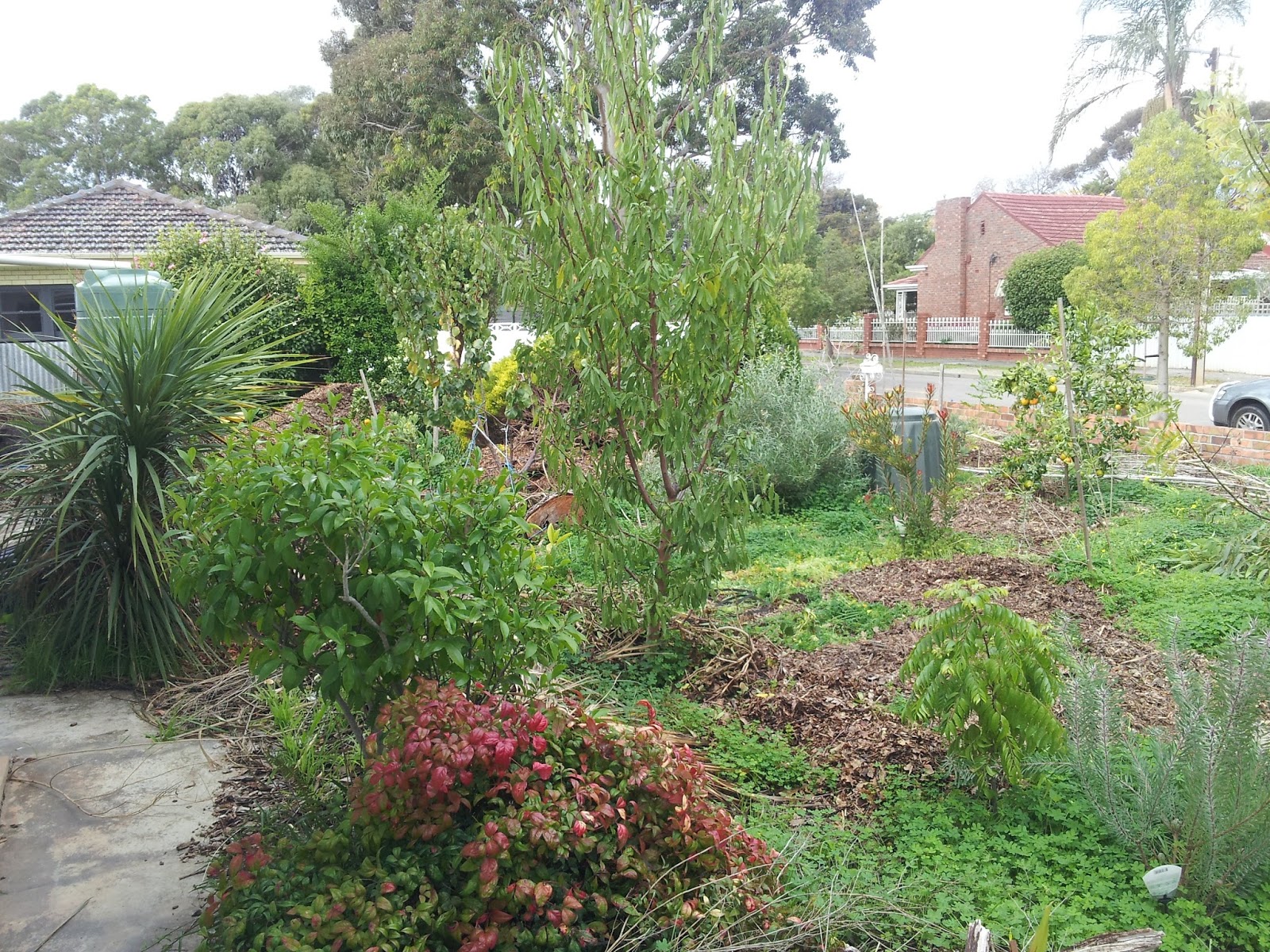
I thought I'd include a few photos of the front garden. We've been here about 18 months and the entire garden was couch grass when we moved in. All the grass is now gone, and there is an average of 150 mm of mulch across the yard with about 12 trees planted.

Mandarin -- this tree has been in the ground for ~21 months, and seems very happy

Almond tree -- this tree has grown amazingly (~21 months in the ground) -- we even had some almonds in April! You can also see the rainwater tank (top left). We had a few discussions about whether it was aesthetically ok to put a rainwater tank in the front yard. I've wrapped wire around the tank and we're growing a passionfruit vine up it. I see us as trailblazing a new garden aesthetic! ;-)

Orange tree -- has a few oranges on it (also in the ground for ~21 months)
I was a bit hesitant as to whether I should let the citrus trees fruit, but I decided to just let them. I guess it's possible they won't fruit next year (because of the stress). Time will tell...

There's lots more work to do here. I want to plant at least another 6 trees this winter. I'm thinking another lemon, and some more nut trees, an avocado (our last one died). Any other suggestions? Out the back we've got apples, pears, nectarines, peaches, plums, walnut, fig...

Wednesday, June 10, 2015

Environmentalists should live in the Real World

Many times, I have seen someone arguing for reduced ecological damage, a carbon tax, a transition to renewables, etc. A response I regularly see goes something like "environmentalists should get out in the REAL WORLD" or "this sounds nice in theory, but it won't work in the REAL WORLD" or "in the REAL WORLD, people don't have time for this"

I think the underlying thinking behind these blanket statements is that the human world of the economy, jobs and politics (referred to as the real world) places hard limits on what is possible for us to do as a society. For example, we can't transition to renewables because of the needs of industry for cheap power. People can't ride bicycles to work because they don't have time. A carbon tax is bad because it is a burden on the economy.

The interesting thing to me, is that this thinking is precisely backwards.

In actuality, all of our prosperity comes from natural systems:
  • food
  • water
  • fuel (including fossil fuels)
  • air
  • materials (eg. plant fibres, mineral ores, chemical feedstocks, animal skins)
The natural systems that provide these services to us are the real world.  Conversely, the worlds of
  • money 
  • economy 
  • finance 
  • politics
are actually completely dispensable. If you doubt this, reflect on the fact that for most of history (say until 5000 years ago) no human society had these things. Even today, some human societies lack one or more. Money, by itself, has no inherent value, meaning or worth -- it is merely a token of exchange. The only reason people see money as valuable is because it can be exchanged for goods and services (all of which eventually come from the natural systems that support us).

So, when someone says "this sounds nice in theory, but it won't work in the REAL WORLD", what they area really saying is "forget about the biophysics of our natural support systems, we must at all costs maintain our arbitrary system of exchange tokens -- that is what is really important"

When put this way, it sounds stupid. That is because it is stupid. It is like the Easter Islanders chopping down their last tree to put up another stone statue (so that they couldn't build more fishing boats and starved). In fact, the similarities are very troubling.
Creative Commons License
This work is licensed under a Creative Commons Attribution-ShareAlike 4.0 International License.