Tuesday, May 30, 2023

How can Australia fight inflation in a fair way?

Summary

We are using interest rates to fight inflation, but they are a poor tool. They penalise the poor and young, and actually cause inflation by giving more money to the rich. There are better ways that we can control inflation, by taxing the wealthy more -- which takes some of the burden away from those who can least afford it, and asks the wealthy to shoulder some of the effort. 
Currently, we are doing precisely the wrong thing by continuing with the stage three tax cuts, which overwhelmingly benefit the wealthy. These need to be stopped, and new wealth and luxury taxes implemented if we are to control inflation in a remotely equitable manner.

How can Australia fight inflation in a fair way?

Inflation occurs when goods and services become more expensive. When this occurs too quickly it causes big societal problems because people's spending power disappears. Because of this, it is important to reduce inflation. Currently the mechanism by which we are doing this is raising interest rates. This is problematic because

  1. it is only affecting a subset of Australia
  2. another subset of Australia benefits from it, and thus tends to engage in more inflationary spending
  3. it is regressive -- high interest rates affect the young and poor the most.
What other options are there?

A quick primer on Modern Monetary Theory

Most people, if they have heard of modern monetary theory at all, think that it is an argument for increasing deficit spending by the government. I believe this is incorrect. MMT is actually a framework for thinking about the government's policy as it pertains to finance and spending - it is not advocating anything at all.

A fiat currency is one that is not tethered to anything. In the past, currencies were often related to precious metals (such as the Roman denarius, which contained a certain amount of silver). In contrast, a fiat currency is just pieces of paper (or numbers on a computer) whose value is literally only what people agree that it is worth. For a government that controls a fiat currency (eg. Australia, UK, USA), the government can literally create money from nothing an spend it. Such governments do this regularly, and have been doing so especially in the last decade of two. For such a government, there is no direct need to tax people in order to spend, because governments can just create new money to spend it on governmental programs.

Here is where the misunderstandings of MMT arise. People erroneously believe that by saying there is no "direct need" that this is a tacit endorsement of governments running up huge debts. MMT is not advocating this (again: MMT is not advocating anything).

However, as I mentioned, it does give a framework for thinking about things:

If governments do not need to tax people in order to spend, then why do they tax?

Governments levy taxes in order to control inflation.

Obviously, if a government is creating lots of additional currency, then there will be a lot more money out there trying to "be spent" on the same pool of goods and services. Supply-and-demand says that if the volume of money is increasing relative to the available goods and services, then the value of the money must decrease. This is called "inflation".

To ameliorate this, governments tax people. In an MMT framework, taxation is effectively the destruction of currency, which helps reduce the amount of money in circulation, and therefore tends to reduce its value relative to available goods and services.


Right now, much of the world is experiencing significant inflation. To try to combat this, central banks have increased interest rates. This is another way to control inflation, because higher interest rates increase the cost of borrowing money (and having debt), and therefore tend to defer spending into the future (high interest rates mean that it's harder to bring spending forward in time by borrowing money).

High interest rates also mean that savers (people with money in the bank) earn more interest on their savings. These high interest rates mean that people with savings are becoming richer, which tends to lead to more spending, which increases inflation. In other words, the very measures that are aiming to reduce inflation (increased interest rates) are also tending to increase inflation.

The social effect of inflation and high interest rates, why the stage 3 tax cuts are ad policy

In Australia, a large number of people are really struggling with inflation, an effective decrease in their wages (relative to prices), and a huge increase in both rent and mortgages. Also, right now, we have bipartisan commitment to stage 3 tax cuts which overwhelmingly benefit large income earners.

Think about this from an MMT framework - tax cuts mean more money floating around, which means the value of the money falls, which means inflation. The strage 3 tax cuts are inflationary -- they are precisely the opposite of what we should be doing. 

This is (partly) why the Reserve Bank is having such a difficult time -- the RBA has only one tool they can use (interest rates) to try and bring down inflation, but Australian governments is pushing inflation up with tax cuts (and other policies).

It's vital to understand that we have a certain supply of goods and services available, and that making more money doesn't make more of the things we want to buy. 

What is actually occurring, in times of inflation, is a competition for goods and services between different parts of society. Right now the rich are winning.

How else can we control inflation?

Let's consider an alternative response to high inflation. We need to reduce the amount of available money, but we don't want to further impoverish people so we decide to try and reduce the spending of the wealthy (which is mostly discretionary). Instead of raising interest rates so quickly and so far,  we could increase income tax for the higher tax brackets (eg. above $150000/pa), remove/reduce negative gearing, and reduce franking credits. If we were feeling adventerous, we could institute a wealth tax. All these measures would reduce the money supply and thus reduce inflation -- and we would have done it without causing so much suffering. Australia would have said to wealthy people "you're still rich, just not as rich as you thought you were"

Sadly, this is not even being discussed.

Instead, what we are seeing is wealth transfer from people who are renting and people with recent mortgages (and little equity in their house) to a much smaller group of people whose wealth is already established and are already rich -- people with a net worth above a couple of million dollars. 

Let's put aside the social imperatives for a moment, and consider the environment.

How does this thinking tie-in with our desperate need to decarbonise our society?

A carbon tax sends a price signal to everyone that we need to reduce our consumption of energy, and also transition from fossil energy to renewable energy. By putting a tax on carbon, we would in effect be preparing ourselves for a future of higher prices. Our failure to retain a carbon tax has not only imposed future environmental costs on ourselves, it also means that we have lost a decade of preparing for higher prices (in fact, as we have seen with the huge increases in enormous diesel cars, we have gone in precisely the wrong direction and are now more vulnerable than ever to price increases).

Let's try and unite the MMT, social, and environmental perspectives.

How could we try and reduce inflation while avoiding the imposition of hardship on people who are already struggling? The important thing is to reduce the money supply, and the easiest way to to that, in a way that doesn't target the poor, is with tax. One approach could be:

 - raising tax rates on high income earners

 - implementing a carbon tax at $100/ton (importantly, this would help reduce the amount of foreign fuel Australia imports and help maintain the integrity of our currency by improving our balance of trade)

 - introducing new taxes to try and reduce the heavy burden that income-earners pay, relative to those with wealth. This might include higher land taxes on non-PPOR, wealth taxes, inheritance taxes, reduction/removal of franking credits.

If some of these measures were taken, we might still have needed interest rate increases, but far fewer than what we have had. We would be taking some of the wealth from the wealthy who have otherwise been out-competing poorer Australians in the competition for goods and services. Also, we would be sending a price signal to prepare for a future of relative energy scarcity, which is coming towards us whether we like it or not.

Final Note:

I am not an economist, nor an expert in modern monetary theory. We desperately need more voices in this economic debate though -- economists largely have significant blind spots when it comes to social, political, technological, and environmental issues. It's worth remembering that, prior to 2022, very few economists thought that a doubling of the money supply might lead to inflation. We need more people to call out high interest rates for the regressive social policies that they are.

Also, while I have an interest in this debate as an engaged Australian who wants to see our country and its people thrive, I am not directly, personally, negatively affected by rising interest rates. I am writing here in what I see as the National Interest, not my personal interest.


Further info:

The Modern Monetary Theory podcast is well worth a listen:

https://pileusmmt.libsyn.com/

David Graeber's 5000 years of debt is an excellent read


Written and published at guesstimatedapproximations.blogspot.com in May 2023 by Angus Wallace

This may be republished with attribution, under a Creative Commons-4.0-BY-SA license license: https://creativecommons.org/licenses/by-sa/4.0/

Monday, October 10, 2022

Will EVs reduce our carbon emissions if we don't change behaviour?

Summary

My last post outlined my idea that switching ICEVs (petrol cars) for EVs (electric cars) is not sufficient to prevent climate change. I wanted to find a different way to illustrate this, so I created a simple mind-sized model. You can download the model and play with it yourself, and form your own conclusions. The model shows that if all new cars bought in Australia are EVs, it is not sufficient to prevent serious climate change if we maintain current patterns of car ownership and use.

If you are buying a new car anyway, it will be less harmful if it is an EV and not an ICEV. However, the best outcome is to retain your existing ICEV car and simply drive it less -- make more use of walking, cycling and public transport instead. Get an ebike or a scooter/moped. This has the added benefit of saving you a lot of money and improving your fitness.

The model

You can download the model here. I've saved it in an Excel spreadsheet for maximum compatibility. If you don't have Microsoft Excel (good on you!) you can open it using LibreOffice, which is a free Office program that runs on all computers. The following assumptions outline my thinking in the model -- these numbers are all adjustable in the model, so if you disagree with my assumptions you can try tweaking them. 
  1. There are 20 million cars in Australia, the total number of cars grows at 1% annually
  2. There are 1 million new cars bought in Australia each year
  3. The embodied CO2 emissions in a new ICEV and new EV are 16.3 and 26.9 tons respectively (as described by Volvo in their article)
  4. The average Australian car drives 12000 km / year
  5. An EV emits 20g / km of CO2 at point of use
  6. An ICEV emits 200g / km of CO2 at point of use

Based on these assumptions, I ran two scenarios:

  • Scenario 1: every new car in Australia is an ICEV
  • Scenario 2: every new car in Australia is an EV

I examined how these two scenarios compare out to 2040, in terms of cumulative CO2 emissions. Below is a graph that shows how cumulative emissions compare under the two scenarios:


Observations:

  • by 2040, the all-EV scenario has CO2 emissions that are 16% lower than the all-ICEV scenario
  • In both scenarios, cumulative CO2 emissions are above 1 Gt (billion tons) 
  • After 2040, in the all-new-EV scenario, almost all cars in Australia would be EVs. If we stopped buying new cars altogether at this point, additional CO2 emissions in the all-EV scenario would be very small
  • our carbon budget is 1.3 gigatons if we want to remain below 1.5℃ of warming. We have pretty much exhausted this budget just on EVs and have nothing left for decarbonising all other aspects of the economy (in other words, we will hugely overshoot our budget, with consequent climate instability)
  • A significant limitation to the model is that not all cars in Australia drive the same amount. If we prioritised changing the highest emitting (furthest driving) cars to EVs, it would have a more significant effect than observed in this model.

Variations to the model

I tried some variants to see what would happen:
  • reducing the EV point-of-use emissions to 0 g/km doesn't significantly change the results
  • increasing the rate of EV adoption to 4 million new EVs / year reduces the total CO2 emissions at 2040 to 0.8 gigatons.
  • setting annual growth in total car numbers to 0 doesn't significantly change the results

Conclusion

  1. We cannot keep driving petrol cars like we do now and maintain a safe climate
  2. EVs are better than petrol cars in that they emit considerably less CO2 at time of use
  3. However, the additional CO2 emitted when manufacturing EVs (compared to ICEVs, which is already considerable) means it takes a long time (approximately 20 years) to achieve emissions-reduction by simply buying new EVs. During that time, we will exceed our carbon budget.
I know this is bad news, and that people won't want to hear it. I'm not happy about it either. 

Monday, September 12, 2022

Does the rise of EVs mean we can maintain car culture?

Summary

We must urgently and rapidly decrease our use of internal combustion engine vehicles (ICEVs). It is important for environmental reasons, but also for our security -- we are currently heavily dependent on oil imports which are likely to become much more expensive (and quite possibly less accessible) in future. Burning oil for transport is unsustainable. We don't have time, and don't have the carbon budget, to replace our existing car fleet while remaining within 1.5℃ or probably 2℃ of warming. 

In general, the EV-naysayers seem to think that we can just keep driving petrol cars forever, and the EV-yeasayers think that technology will work it all out so that we don't have to change our lifestyle. 

I think they're both wrong: EVs, while considerably less-bad than ICEVs, are not good enough to prevent catastrophic climate change if we keep the current patterns of private vehicle use. We urgently need to find another way to decarbonise transport.

If you are going to buy a new car anyway, you should definitely buy an EV. However, if you do buy one you should still try and limit car use and share your EV with others -- this will mean that more value is obtained from its embodied carbon, and hopefully you can reduce the likelihood that others will buy new cars. The only way we are likely to meet our climate goals is by sharing EVs, so this aspect is essential.

Introduction

Currently, Australia has a plan to make transport sustainable. Our plan is something like:

Let's transition all vehicular transport to electric vehicles. These vehicles will be powered by renewable power which will decrease the climate impact and make transport sustainable.

The problem is that we've never really examined this plan to make sure that it will work. The main thing that most people focus on in this plan is the transition to private EVs. For these to work (by which I mean: be sustainable), we need to satisfy the following criteria:

  1. We need to be able to make EVs quickly enough to matter, so that we can quickly swap our existing car fleet over to EVs. 
  2. The process of manufacturing/distributing the electric vehicles needs to remain inside the biophysical limits that we have. The most familiar of these limits is our remaining carbon budget -- however, water consumption and minerals availability are also very relevant.
  3. EVs need to be a large-enough improvement over ICEVs that we meet our sustainability objectives (eg. the total lifetime emissions of EVs need to be sufficiently less than ICEVs that we can get back "under the curve" of biophysical overshoot)
  4. People need to be able to afford them

Let's look at each of these points in turn:

1. Can we make EVs quickly enough?

Let's get a sense of what is needed. There are approximately 900 million cars in the world globally, and about 20 million cars in Australia. It's hard to get precise up-to-date numbers, but there are about 50000 EVs in Australia (about 1 car in 400), and between 20 and 30 million EVs globally (about 1 car in 500). Currently, rates of production are doubling annually. Thus, it seems plausible that we can make enough vehicles in the next decade if this trend roughly holds.

However, currently the average age of a car in Australia is about 10 years. Hence, this process of replacement will quickly slow as we saturate new cars with EVs. From when 100% of new cars are EVs, it will take close to a decade to replace Australia's entire car fleet. So, even though we might be able to make EVs quickly, people can't afford to buy new cars to replace their existing ICEVs. This suggests that a plan that depends on transitioning private transport to EVs is unlikely to work because we can't swap them over quickly enough.
It's also not yet clear how much utility remains in an EV after 10 years' use. People may not want them.

2. How does the process of manufacturing EVs fit within our biophysical limits? How does it compare to an ICEV?

Volvo have released some helpful data about EV vs ICE embodied carbon. Here are the data, which I sourced from https://www.volvocars.com/images/v/-/media/market-assets/intl/applications/dotcom/pdf/c40/volvo-c40-recharge-lca-report.pdf, page 25

I'm using these data to generalise to all EVs. We just want a rough estimate, so I think this is reasonable.

Carbon footprint of Volvo ICEV vs EV

In terms of manufacturing-related emissions. The tally looks like this:

  • Volvo XC40 ICEV: 15.7 tons
  • Volvo C40 EV: 26.4 tons

Volvo's report states that: 

Although total emissions from all phases except the use phase of the C40 Recharge are higher than for the XC40 ICE, the C40 Recharge will over the span of its lifetime cause less emissions thanks to lower emissions in the use phase. Where this break-even occurs depends on the difference in GHG emissions from the production of the car, and how carbon intense the electricity mix is in the use phase.

For all three electricity mixes in the LCA [lifecycle analysis], the break- even occurs at 49,000 (100% wind), 77,000 (current EU average) and 110,000km (global average) respectively, all within the assumed life cycle of the vehicle (200,000km).

I often hear this concept of "break-even" used in this way. It is a mental error, let me explain why.

"Break-even" is bogus

When people talk about "break-even" they are making a comparison against something. In this case, the break-even is being calculated versus the purchase of a brand new petrol car. Volvo are essentially saying "assuming that you are buying a new car anyway, if you buy an EV instead of a petrol car, once you have driven 48000 km your emissions will be lower than they would have been if you bought a petrol car". (It's a bit like a clothing shop telling you you've saved $25 when you bought a new pair of jeans that were discounted -- in reality, you've only saved $25 if you were intending to buy the jeans at full price anyway).

Below is the graph showing, over time, how the four different scenarios play out:

Expected total GHG emissions of EV vs ICEV from Volvo. Note that producing a new Volvo X40 (EV) release approximately 26 tons of carbon dioxide, and producing a new Volvo  

The dotted line shows total emissions from a new petrol car, and the three solid lines show EV emissions which very depending on the electricity source from about 40% to 80% of the petrol car's emissions.

There are two scenarios that Volvo haven't considered:

  1. keep the existing petrol car and maintain existing driving habits
  2. keep the existing petrol car and drive less
(I can understand why Volvo don't want to encourage either of these options)

From Volvo's own data, we can estimate how these two scenarios would compare to the scenarios they explore. In the following figure, the first four rows of data are the same as in the image from Volvo's report. The bottom two are estimates, based-on Volvo's data.


If we compare against the scenario of "keep existing petrol car and existing driving patterns", then EV "break-even" looks like follows:

  • global electricity average: 270000 km*
  • EU electricity average: 190000km*
  • wind power only: 125000 km
If we compare against the scenario of "keep existing petrol car and drive half as much", then EV "break-even" occurs like follows:

  • global electricity average: never*
  • EU electricity average: never*
  • wind power only: 250000 km*
(I have put a star next to some of these, which indicates that payback will occur outside the warranty on the battery, which is typically 8 years or 160000 km)

These data are shown in the following exploratory time series model. The first four lines are the same as those in Volvo's figure (above). The additional two lines correspond to the "keep existing car" and "keep existing car, drive half as much" scenarios, as described. It shows the "break-even" between "keep car" and "new EV (wind)" occurring at 125000 km, and the "break-even" between "new EV (wind) and "new XC40" (petrol) occurring at 48000 kms. 
Note that the "keep car, drive less" drives 1/2 the distance of the other scenarios (i.e. where the X-axis is labelled 200000 kms, it has driven 100000 kms). This is the least complex way to show the difference in behaviour in an easy-to-understand figure.


In other words, even if we buy an EV, drive the same, and charge it with 100% windpower, it takes 125000 km of driving until we have "repaid" the carbon emitted in its manufacture. In all other cases, environmental "break-even" will not occur during the warranty period of the battery.

To me, this suggests that two of the criteria listed at the start of this essay are not met by transitioning our private car fleet to EVs -- EVs are too costly (in environmental terms) to manufacture, and they don't help reduce carbon emissions enough (largely because of their environmental cost to manufacture). Because of their significant up-front environmental cost, we can't make enough of them to replace every petrol car with an EV. 
EVs are great, but we just can't replace every petrol car with an EV.

3. How many cars can we replace with EVs?

As mentioned earlier, according to Volvo, the manufacture of each EV releases 26.4 tons of CO2.  
There are 20 million registered cars on the road in Australia. In 2019, we had less than 3.3 gigatons of carbon budget remaining to stay under 2℃ and less than 1.3 gigatons to stay under 1.5℃.
To replace those 20 million registered cars with EVs would release 20M*26.4 = 528M or ~0.5 gigatons of CO2, which is about half of our total carbon budget if we want to stay below 1.5℃ of warming.
That is almost 1/2 of Australia's carbon budget, just to manufacture a new EV to replace each existing ICEV. 
It doesn't allow us to build the extra electricity generation capacity we will need to actually charge the EVs, it also doesn't help us decarbonise any of the following:
  • energy,
  • agriculture, 
  • medicine, 
  • manufacturing, 
  • mining, 
  • construction, 
  • waste disposal, 
  • sewerage treatment.

If we follow this plan, we will spend 1/2 our remaining carbon budget to partially fix a small part of our problem. Transport causes somewhere between 10-20% of Australia's emissions, so to spend half our carbon budget only reducing emissions for part of transport (passenger EVs doesn't fix freight, air travel, rail, busses) doesn't add up.
Again, the problem is not that EVs are not good -- the problem is that we can't replace every petrol car with an EV.

Conclusion

Let's revisit the four criteria I suggested at the start. Below are the requirements that must be met for EVs to be useful at weaning us from oil powered transport.

1. We need to be able to make EVs quickly enough to matter, so that we can quickly swap our existing car fleet over to EVs. 

I think this is questionable. Even if it is possible for us to make them this quickly (which is uncertain) I don't think we can persuade people to buy them unless we have significant government incentives. These incentives would need to be means tested, and target people who are currently buying vehicles in the $500-$10000 range.

2. The process of manufacturing/distributing the electric vehicles needs to remain inside the biophysical limits that we have. Conceptually, the simplest of these limits to consider is our remaining carbon budget, but water consumption, minerals availability are also very relevant.

I think it is clear that we cannot manufacture enough EVs to replace all existing personal ICEVs and also decarbonise the other parts of our economy that we must if we are to keep within 1.5℃ of warming

EVs need to be a large-enough improvement over ICEVs that we meed our sustainability objectives (eg. the total lifetime emissions of EVs need to be sufficiently less than ICEVs that we can get back "under the curve" of biophysical overshoot)

I think it's apparent that the significant manufacture costs (carbon emissions) of EVs means that we don't avoid enough emissions if we swap our ICEVs for EVs and keep everything else the same.

People need to be able to afford them

This is unclear, but I think it unlikely without significant government intervention.

Solutions

So what should we do? The numbers are unequivocal -- we must drastically reduce the use of the private car, and it doesn't matter much whether the car is an EV or ICEV. We simply lack the technology to make private cars sustainable, and trying to cling to this idea makes meeting our climate goals impossible.

We must replace ICEV cars with EVs, but we can't replace every ICEV with an EV. Therefore, we need to come up with a way to reduce our car dependence (so that fewer trips need a car) and a way to share EVs (so that one EV can serve several people)

Therefore, we need to embrace public transport, walking, and cycling. These need to become our default transport options, saving private motor vehicles for the trips that actually need them. We need to make use of car sharing platforms (such as Car Next Door) to allow a relatively small number of EVs (maybe 1 million EVs -- where each EV is shared by 20 people) to serve all Australians (reducing the number of cars in Australia by 95%).

Sunday, August 7, 2022

In the age of cheap solar PV, does electricity conservation still matter?

Solar PV is an amazing technology. It has low emissions compared with other electricity generation method. Also, it is decentralised and thus can easily be retrofitted.

Today, it is possible to buy a good-quality 10 kW solar PV system from about $7500. Such a system, installed on mainland Australia, will produce an average of up to 20 kWh/day in winter, and close to 60 kWh/day in summer. Given how cheap that system is, and how much electricity it will produce, should we still need to be concerned with reducing energy use?

I think the answer is yes, for the following reasons:

1. For most residential solar PV installations in Australia, self-consumed power is black (not green) power

When you buy a solar PV system in Australia, the cost of the installation is offset by STCs. An STC represents 1 MWh of renewable electricity from a small-scale generator (eg. a domestic rooftop solar PV array). A new solar PV system creates a number of STCs equivalent to the renewable electricity it will generate over its expected lifetime. To make a solar PV system cheaper, people usually sell its STCs.

To whom are the STCs sold? People buy STCs when they buy GreenPower or want to offset other polluting activities. By buying STCs, someone is buying GreenPower.

The consequence is: if you have sold your STCs, then your self-consumed solar PV power (power that you use direct from your panels, rather than the grid) is actually black power -- you have in effect sold the renewable power coming from your panels (the STCs), and are instead using power from the coal power station, even if the electrons have come from your panels and not the grid, you have sold their "greenness".

Thus, the idea that you are using clean power direct from your solar PV is not accurate.

If you think "maybe some people do this, but I didn't do it", you're probably wrong. Take a look at your quote or invoice for your solar PV installation (mine is below) -- the vast majority of people (more than 90%) sell their STCs. Below is the price summary from my original PV installation in 2013 -- the STC sale reduced the cost by 1/3 so any power I self-consume is effectively black power.

My 2013 solar quote including STC sale
It's still great to install solar PV, even if you sell the STCs. By doing so, you are investing in a distributed renewable grid in Australia. While we should not let the perfect be the enemy of the good, we should keep in mind the limitations of what we have achieved so far.

2. Australia still gets a fairly small proportion of its electricity from renewable sources

In the last year, Australia's NEM (National Electricity Market) was about 1/3 renewable. We have a long way to go (Fig. 1)

Figure 1: breakdown of NEM generation over the last year
https://opennem.org.au/energy/nem/?range=1y&interval=1w


However, although we have a long way to go, we are running out of time to get there. Some scientists think we have already run out of time to prevent some dangerous climate change. This article was written in 2018, and among other things says: 
we are only three years away [2021] from overshooting the 1.5℃ target 
...
While it may already be too late for Australia to make a fair contribution to keeping global warming at 1.5℃, our results show that we can stay within our share of the carbon budget for 2℃ – provided we have the political will to move fast.
...
But the overriding message is that time is of the essence, if we want to come anywhere close to limiting dangerous climate change. Our various scenarios suggest that even if we implement a rapid, effective response, we are likely to have to take CO₂ back out of the atmosphere in the future, to compensate for the likely overshoot on our share of the global carbon budget.

Note that there are no confirmed, scalable, affordable, methods for extracting CO₂ from the atmosphere, and many scientists do not consider the 2℃ limit to be safe, as outlined here.

3. Currently, the manufacture of renewable energy technologies releases CO₂ into the atmosphere, using our carbon budget.

While solar PV and wind power are our best (and perhaps only) bet for achieving a sustainable electricity  supply, their production does cause carbon emissions (though vastly less than continued use of coal and gas does). Given the highly constrained carbon budget we now have, even the relatively small contribution of wind turbines and solar PV manufacturing will likely become significant.

carbon footprint of various electricity generation methods. Solar is about 20x better than coal, but it still has an environmental impact. Also note that the environmental impact of solar is "front-loaded" meaning that the impact of its entire lifetime of generation is brought-forward. Regarding "coal with carbon capture" -- note that this has not been commercially viable anywhere in the world. https://cdn.factcheck.org/UploadedFiles/co2-emissions1.jpg


4. We cannot manufacture wind turbines and solar PV quickly enough to supply all current grid electricity in time to avert serious climate change

Some models suggest Australia's grid will be 50% renewable by 2025 and 69% by 2030, becoming fully renewable in the mid 2030s. Recall the 2019 model suggesting that our carbon budget may already be exhausted -- this suggests that our deployment of renewable electricity will not be rapid enough to remain within the safe levels of carbon.

Implications

So, are we stuffed? I think the answer is "not necessarily", because all these analyses miss the thing that is easiest to change -- demand.
Let's consider per-capita energy consumption around the world:
https://www.quora.com/How-is-the-consumption-of-electricity-a-reliable-indicator-to-track-the-economic-growth-of-a-country
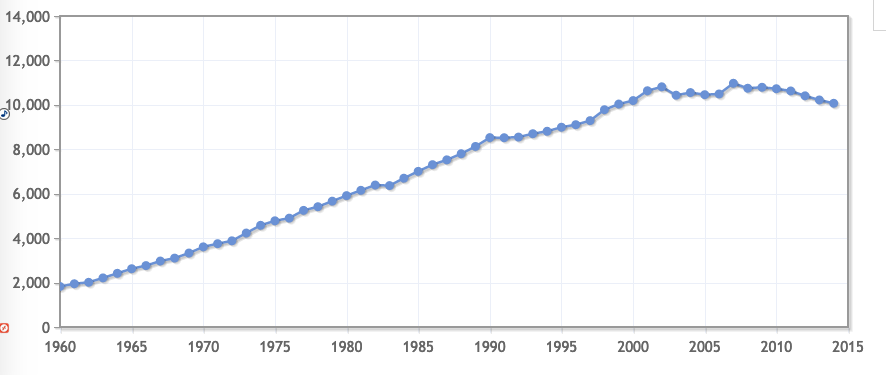
If you examine this graph, you will see that Italians use about 1/2 the energy that Australians use. This suggests that we could halve our energy consumption without making significant changes to our society. The percentage of renewables in our grid would go from 1/3 to 2/3 in that process without having to install any additional capacity. Italy is a nice place -- Australians like to go there for a holiday because it's so nice. 

Let's consider look at Australia's historic consumption:
Australia per-capita electricity consumption (kWh per person)
https://www.indexmundi.com/facts/australia/indicator/EG.USE.ELEC.KH.PC

In 1960, Australians used 1/5 the electricity that we do today. 

I downloaded data on Australia's historic energy consumption and corrected it (fairly roughly) by population to create per-capita relative consumption for each year. To me it looks like per-capita energy consumption hasn't changed a lot. The data only start in 1974. (I couldn't easily find older data)
per-capita energy consumption in Australia, 1974-2020

However, in the 70s, many (most?) consumer items (eg. cars, building materials, clothing) were made in Australia, so the embodied energy of the things we bought is included in the figure. However, by 2020 that was no longer the case and our energy consumption is effectively much higher than shown because of our reliance on off-shore industry. Also note that our domestic energy consumption has remained fairly constant even while we've had huge efficiency dividends because of technological improvements.

To try to illustrate this, I accessed Australia-China trade data, looked at the RMB (Chinese currency) value of Australian imports from China, scaled them by the average energy intensity of the Chinese economy (approximately 200 RMB per kWh), scaled that by the carbon intensity of Chinese electricity (2 MWh per ton CO2 -- this is about 1/2 the intensity of coal power) and scaled that by Australia's population to create a Australian per-capita estimate of Chinese CO2 emissions that arise because of the manufacture of Australian-bought products (and are hence our responsibility). This is obviously prone to error, but gives an indication. Note that these data only started in 2012. 

per-capita energy consumption in Australia, including the Australian equivalent per-capita from Chinese manufacturing of Australia-bound goods. 1974-2020

I think it shows that our domestic per-capita coal and oil consumption has remained consistent, our domestic gas consumption has significantly increased, and our foreign coal consumption (embodied in goods we buy) has gone through the roof.

This graph looks somewhat unbelievable. To sanity-check it, I considered the size of the total Chinese economy to estimate the per-capita emissions on current data only:


This data are similar to what is shown in the graph above, but were arrived at differently, suggesting that the numbers are meaningful.

To be honest, these numbers are quite shocking and should give Australians pause for thought.

Conclusion

The easiest and best way to quickly get closer to our goal of being zero carbon is to use less electricity and buy fewer manufactured products. This is true whether you have solar PV installed or not -- installing solar PV does not absolve you of a responsibility to use less.

If you think that Climate change is a problem to take seriously, I challenge you to use less than 2.5 kWh of electricity per person per day (eg. 10 kWh/day for a family of four). You can party like it's 1965 right now!
The Beatles say: just flick that switch off, baby!

If you want to read more, here's a short essay I wrote in 2014 about the merits of the 1950s -- yes, there was good amongst the bad, and we would do well to learn from those who lived then.

Wednesday, August 26, 2020

Efficient at what?

It is common to hear people talk about the efficiency of this-or-that system. Being "efficient" sounds like an unequivocal good, but the question that must be asked is "efficient at what?"

To illustrate this, let's consider "A tale of two heaters" in an average Australian living room.

Heater A is a split system heat-pump. It draws 2 kW of electricity, and outputs 8 kW of heat (it does this by pumping heat from outside the house to the inside of the house). For every 1 kWh of electricity it uses, it puts 4 kWh of hot air into the living room, and has a coefficient-of-performance (COP) of 4.

Heater B is a far-infrared panel (FIR). It is a resistive heater that emits infrared light, and needs to be directed to the occupant to be effective. As a resistive heater, it outputs 1 kWh of directional heat for each 1 kWh of electricity it consumes -- its COP is 1. Let's say it draws 1 kW.

Many people would say that Heater A is "more efficient", and there is some justification for this: for a given electricity consumption, heater A puts more heat into the room than does heater B.

However, because Heater B is targeting its heat directly at the occupant, it doesn't need to put so much heat into the room for the occupant to feel warm. Hence, one can argue that the amount of energy required to provide the service (making the occupant feel warm) is less and hence the FIR is more efficient because it uses less energy to make the person feel warm.

Hopefully, this example shows that when talking about efficiency, it is very important to be clear about exactly what we are doing efficiently. 

Deep problems with efficiency

But the problem goes deeper than this. 

In the 19th century, Britain was worried about running out of coal. At the time, coal was the fuel that drove the factories and war machine that made Britain the world's preeminent power. Some people thought that, as the machines became more efficient, coal consumption would be reduced.

William Jevons argued the opposite -- that an ability to use the resource more efficiently would actually drive increased demand in the resource. He noted that coal consumption rapidly increased after James Watt's more-efficient steam engine, because Watt's new engine made the exploitation of coal much more profitable.

This has become known as Jevon's Paradox, and the Wikipedia article contains much more detail.

We face the same phenomenon today -- improved technology that allows people to climate-control their houses more cheaply has meant that people perform more climate control. Whereas in the early-to-mid 20th century, an internal house temperature of 13 degrees was considered acceptable, it no longer is. Some people even heat their houses to 24 degrees.

Even if you don't do this, consider what you do with the money you save by spending less on fuel -- if you use that money to take more air travel, or to buy more manufactured goods, then you are a living demonstration of Jevon's Paradox.

In a society where 70% of grid electricity comes from coal, as does probably above 90% of the embodied energy in many manufactured goods (such as PV panels), it is simply not good enough to be "efficient".  Efficiency, by itself, will not reduce carbon emissions -- not even in theory.

The only solution is to focus instead on reducing consumption.

Wednesday, June 5, 2019

FAIL: wicking beds that don't last

I have written several articles about building cheap wicking beds using mixed materials and lined with builders plastic to form a reservoir. Unfortunately, these beds simply do not last. The builders plastic develops a leak, roots get in, and the reservoir fails. I am trialling a bed using pond-linear (which is quite a bit thicker), however experiments with a reed-bed made with pond-liner (it leaked!) suggest that this is unlikely to work.

For now, I am transitioning my leaking wicking beds (I think three of four are leaking) to IBCs, which I am hopeful will have better longevity. I will document this more in future.

Monday, March 18, 2019

The cost of travel

Summary

This essay examines the carbon cost of travel using different modes of transport, and compares it to other sources of carbon emissions (eg. electricity). It finds that international air travel is a significant source of carbon emissions, especially for people with an efficient house who fly regularly.
Compared to phasing out coal power (a noble goal), phasing out air travel would have a similar impact per-capita for regular flyers.
If middle-class Australians expect coal communities to make personal sacrifices to reduce the emissions intensity of Australia's electricity, I think it is reasonable to ask middle-class Australians to fly less.

Introduction

In times past, only the wealthy could afford to travel. This was for the simple reason that most people were so poor that moving any significant distance from their home was unaffordable. And, of course, they had to work all the time.

Also energy, or the ability to do work, was so expensive that to travel took a long time (because to travel quickly takes much more energy than to travel slowly). Let's get a perspective on how much energy travel consumes.

This first figure shows the energy output of a human, an ebike, and a horse
Clearly, the ability of a person to do work is tiny compared to a horse -- it takes approximately 10 people to equal the power output of a horse. Horses are pretty powerful! Let's get a bigger perspective:
Suddenly, the horse doesn't look so powerful anymore! Even a small car can produce the power of many horses. The power output of a car is so great that the human output looks like nothing.

Of course, there is a difference -- the power output of both small and large cars is unsustainable (at least for the vast majority of cars which burn fossil fuels), and is causing changes in the Earth's climate that will be paid for by people in the future. Clearly, if we want efficient transport we should avoid cars.
Here we add air travel to the graph. This makes all of the sustainable transport look like it uses no energy at all. Note that for the cars and the plane, I assume that the car has 4 passengers, and the plane is completely full. Also, per-passenger energy consumption of the plane will be larger for business- and first-class passengers (because they take up more space).
Note that it is possible, at least in principle, to electrify car transport. Electrified air travel is currently science fiction. Note also that, currently, more than 60% of Australia's electricity is generated using fossil fuels.

Distance travelled

The figures so far show the energy consumption of different modes of transport, however, clearly people can travel more quickly by air than by foot or bicycle. However, the ability to travel quickly means that people tend to travel more. For example, one would never try to cycle from Sydney to London for a week or two of travel, but with air travel people do precisely this.

The concentration of vast amounts of power to allow air travel is a way for us to cram even more power consumption into our lives.

Let's look at the carbon emissions for different trips to get some perspective:
As before, buses, cars and planes are full and emissions are per-passenger.

Travel vs coal electricity

To reiterate, these numbers are large -- one person flying from Sydney to London produces more than 1.5 tons of emitted carbon. In comparison, in Australia some people (me included) make a fuss about getting rid of coal power because of the environmental impact. The average Australian household uses about 30 kWh per day (this is a huge amount of power), which is just under 11000 kWh per year. The average household has 3 people in it, so that is 3700 kWh/person. Coal power in Australia emits huge quantities of carbon per unit of electricity produced -- it is about 1 kg per 1 kWh. Thus, annual emissions from an average Australian's electricity use is about 3.7 tons.
A one-way flight from Sydney to London produces are much CO2 as 1/3 of annual electricity emissions, if electricity came from 100% coal.


These numbers become even worse if you consider an efficient house (which should be our goal). If you use 8 kWh per day, in a household of three, then one person's annual emissions under a 100% coal scenario are 8 /3 * 365 * 1 = 970 tons/year. A one way flight from Sydney to London is about two years' worth of emissions for this person.

Air travel as a proportion of total carbon emissions

While air travel comprises a relatively small proportion of Australia's total emissions (about 5%), there are hidden costs that are put into other sectors, such as the provision of fuel. Also, the proportion of carbon emissions from air travel is one of the fastest-increasing sectors, and it is also one of the most discretionary -- air travel can be easily reduced. Also, air-travel is a particularly damaging form of carbon emission because of its location in the upper atmosphere.
I have not been able to find statistics, but I suspect that there are a relatively small number of Australians who engage in a relatively large amount of air travel.

Conclusion

There is an increasing push in Australia to phase out coal power and replace it with renewables. This is a good thing. 
However, there is little awareness that carbon emissions from international air travel are similar to the emissions from 100% coal power for average electricity use in Australia. (This is especially true for wealthier Australians that might fly every year).
If middle-class Australians expect coal communities to make personal sacrifices to reduce the emissions intensity of Australia's electricity, I think it is reasonable to ask middle-class Australians to fly less.

References:

https://en.wikipedia.org/wiki/Horsepower
https://en.wikipedia.org/wiki/Human_power
https://www.answers.com/Q/What_is_the_horsepower_of_one_engine_in_a_Boeing_747
https://reneweconomy.com.au/graph-of-the-day-how-green-is-your-electricity-12278/

Sunday, February 18, 2018

The (potential) problem of distributed energy storage

Over the last 18 months, there have been significant developments in the debate around renewable energy in South Australia. Here are some:
  1. South Australia had a state-wide blackout. It was variously attributed to a storm, wind turbines, renewable energy, the Australian Energy Market Operator, the phase of the moon, and probably other things.
  2. Load shedding (also known as brownouts, or rolling blackouts) was applied to 90000 households in SA on the afternoon of a particularly hot day. This was apparently triple what was requested by the market operator to maintain grid stability, and occurred at a time when a gas-fired power station at Pelican Point (in Adelaide) was idle.
  3. Elon Musk, the CEO of Tesla, told South Australia that Tesla can fix our energy problems in 100 days or it's free -- and has completed the installation of the "big battery" within that 100 day period
  4. The South Australian government released a comprehensive plan calling for grid level battery storage (100 MW), a government owned gas turbine and other energy initiatives
  5. Malcolm Turnbull has proposed an upgrade to the Snowy Mountains hydro facility that will allow it to operate as a pumped hydro plant (effectively a huge battery)
Whew! On top of this, there have been calls to the SA government that, as well as embracing a grid-level battery storage system, they should pursue distributed residential energy storage using a scheme such as Reposit (AGL is also rolling out such a system now, called the virtual battery). The Liberal party, as part of their platform in the upcoming election, are also proposing to subsidise home battery systems in some sort of virtual battery system. This is an internet-coordinated distributed power company that manages home batteries to release energy to the grid during times when the short-term cost (spot price) is high. Households can make money by doing this.

I think this is a great idea, and it's commendable that such policies have bipartisan support in South Australia. It is good for people in cities to install battery storage systems, as long as they remain connected to the grid. There are a few reasons I think this:
  1. The grid is a sunk cost. It's already built so we should use it
  2. Generally speaking, shared resources are used more efficiently. Let's assume that 5% of houses have a battery installed (in a few years time). We, as a society, will be much better off if those batteries are used to stabilise the grid during times of peak demand, rather than have those households disconnect from the grid. Those households should be paid for the service of course!
  3. Distributed power is a good thing because it lessens the load on the grid and improves resiliance (there is not a central point to fail), it also reduces power transmission losses.

The problem

One of the big benefits of having distributed power supplies is that of resilience. If one (or a few) systems fail or are disconnected it probably doesn't matter for the grid as a whole. It lessens our dependence on the grid as a whole, and so improves resilience.

But... although it decreases reliance on the electricity grid, it greatly increases reliance on the telecommunications grid. The internet is vital to coordinate the distributed "virtual" battery. Without the distributed batteries being able to talk to each other and the central controller, which needs to get data from the grid, it is impossible for them to coordinate their activities and the system ceases to function properly (for example, with no internet, it becomes impossible for the grid to request delivery of power from the distributed storage at a time of need).

Do not believe technical people who tell you a system is secure. It is not secure -- it is only a matter of time until software or hardware vulnerabilities are discovered and exploited.

A mitigation

"Solution" is the wrong word here: it's not possible to remove the consequences of attacks -- we can only reduce their consequence and likelihood of success. The distributed battery system needs to communicate, and that communication is inherently insecure. The system needs to be built so that it is resilient to internet-based attacks at the system level. I am not an expert in internet security, but here are my thoughts:
  • The system should be designed with security in mind. The critical aspect of the system is its ability to respond to legitimate internet instructions (only!) and react accordingly. The designers need to be aware of the inherent risk of exposing such command and control interfaces to the internet. The security team should have oversight across all teams during the development of this system. There needs to be robust testing of the system(s) (at all levels, from low level to high level) to examine the security implications of design and implementation decisions.
  • The system should be heterogenous. There should be many types of devices communicating on an agreed open protocol. Having many types of devices means that, even if some of them are compromised by an attacker, they are unlikely all to fail (they will be based on different hardware and software making it unlikely that a universal security vulnerability exists). This represents security through diversity.
  • The system should fail-safe. The internet should not be the only method of communication between devices. They should second-guess the instructions they receive from the cloud, by performing their own assessments of grid stability. For example, the grid can use frequency modulation to signal whether more generation capacity is needed (eg. if the frequency starts to fall from a nominal 50 Hz to 49 Hz, that is a recognised signal -- this needs to be preserved as a signalling method). In this way, the devices should use the internet as a communications channel where it is available, but not be dependent on it for all aspects of their function.
  • User interface elements should be kept separate from the control systems. User interfaces are almost always less secure than system interface elements. This is because user interfaces have the added constraint of usability, which is often at odds with security requirements. User interfaces should be through a seperate cloud/web portal that has no direct connection to the system interface.

On many occasions, systems have been designed to use internet platforms with the unconscious assumption that the internet is both safe and persistent. The internet is neither of those things. I hope that the designers of distributed storage are mindful of this, so that their system(s) will be resilient in the face of unexpected communications downtime or malicious attacks.

Thursday, December 7, 2017

What's in store for Australia?

We’re a pretty complacent bunch in Australia. Not surprising really — we had a bit of a scare in 1942 when Singapore fell to the Japanese, but we haven’t been invaded in modern history. During world war two, we had the Americans to help us. However, it looks like we can’t rely on American support in the Western Pacific for too much longer.

One of the sayings about getting old is that the age we perceive ourselves to be lags our actual age by about ten years. I think a similar adage applies to world events: Reality tends to outpace our awareness. Consider the collapse of the British Empire: in 1940, most people would have considered Britain a world power, by 1948 they were a very diminished people and had lost most of their colonial possessions. Of course, events such as Indian independence and the fall of Singapore didn’t just happen in 8 years — the seeds for this were sown earlier (though most people didn't notice).

It seems likely to me that we will see similar shifts in fortunes in the first half of this century as American power wanes. Both China and India are expected to have larger economics than the U.S. by 2050.

(This article is not an attempt at scaremongering — I think that an increase in power/wealth for other countries needs to happen and this means a commensurate decrease in power/wealth for Western countries. However, I would like Australia to maintain an independent parliamentary democracy while this happens -- I would rather live in a poor democracy than a wealthy tyranny)

Let’s think about what it will mean when we can’t rely on the U.S protecting Australia’s interests in the Western Pacific.

Australia is a country of 25 million. 2500 km to our North is Indonesia, with a population of 250 million (ten times bigger than Australia) and projected to be the world’s 4th largest economy in 2050 (with a projected GDP 4 times larger than Australia's). The Philippines and Vietnam are expected to be the 19th and 20th biggest economies (both economies larger than Australia). China and India will be number 1 and 2.

In other words, Australia will be a large, wealthy, (relatively) underpopulated country rich in natural resources in a region of heavily populated much larger (and much richer) countries. The world will be greatly resource-constrained by 2050 — our neighbours will need what we have. Note also, that though Australia's economy will be similarly-sized to the Philippines and Vietnam, a lot of Australia's GDP is tied up in unproductive activities such as home renovations and car modifications -- thus, the industrial output of Vietnam and the Philippines is likely to be substantially larger than Australia even if the GDP is similar.

What happened in the past in similar circumstances?

In the 18th and 19th centuries, Britain was the rising world power and wanted natural resources. They established the British East India company (the basis for British colonialism) which basically had license to do anything required to obtain resources. Such “trade” usually occurred at the point of the sword — it really was theft/conquest and nothing more.

For example, the Chinese Emperor banned opium in 1839, so Britain attacked China. In the end, the Chinese were forced to accept a treaty allowing the British to import opium into China. Another example: before British colonialism, India was one of the wealthiest countries in the world. When they became independent they were one of the poorest. Today, a tour of British museums and estates shows gold and jewels from the subcontinent -- the plunder of empire.

Which brings us to today. This year, the Australian government said it would restrict gas exports to maintain domestic supply. This is a policy that makes sense, in much the same way as the Chinese Emperor’s banning of opium. However, the Australian companies that this law affects have long term contracts with Chinese customers, and this law is definitely not in Chinese interests. Basically, it could cause Australian companies to renege on deals with Chinese companies.

If it was the 19th Century, and this was done to the British East India company, I would expect them to sail their warships into Sydney harbour and bombard the city, to teach the impetuous Australians a lesson in humility (pretty much exactly what Britain did to China in the First Opium War). The treaty we would be forced to sign would likely include the appointment of a British Governor who had authority over the Australian government. One does not break contracts with an Imperial power. [1]

Remove U.S. force projection from the Western Pacific, and there is little to stop China, India or Indonesia from doing the same to us.

Which brings us back to population. I am not a proponent of a “Big Australia”, and I think that Australia’s population probably already exceeds its long-term carrying capacity. Having said that, I think that Australia’s population could well hit 100 million this century whether we want it or not. There is simply too much opportunity here. If we try and prevent it, we will likely be invaded by larger, more powerful neighbours (once the U.S. can no longer protect us). It's worth underlining that we are ethnic/cultural outsiders in Asia, and that our ancestors (or people very similar to us) conquered pretty much every Asian country and stole their wealth (I guarantee that no one except Westerners has forgotten this).

Australians need to understand and accept that we are a very small fish in a very big ocean. Our delusions of Australian specialness and superiority will bring us a world of pain. We have a deep belief, based on centuries of cultural/military dominance, that we are superior. That dominance is ending, and with it needs to go our arrogance. The sooner we see our geopolitical neighbours as equals (and show then appropriate respect) the easier our future is likely to be.

How can Australia pull this off?

We need to increase our population and industrial/agricultural output without putting additional strain on the biosphere or economy (a tall order for a country already in overshoot). This means a significant cut in discretionary consumption to free those resources for the needed expansion (see other articles on this blog for suggestions here). I suggest a targeted program of skilled immigration, coupled with large programs to build agricultural, educational, scientific, and industrial capacity. We can't afford so much waste and unproductive capital.
Such cuts in discretionary consumption might seem an undesirable thing to do -- but it's worth remembering that in the past, wealthy societies that have failed this sort of test have been overrun by other societies.

I'm sure most Australians want to avoid that.


-------------------
[1] Over the years, I have heard many people say things like "China is not expansionist" or "Asian people are less assertive" and therefore Asian people are less likely to seek geopolitical power in the same way that Europeans did. I think this is very naive. For the case in point, see Japan in the early 20th century. They had been inward focused for centuries before their imperial expansion from 1905 to 1945. Asian history is just as bloody as European history. The main reason that Asian people might have seemed submissive or non-aggressive to us is that they were a conquered people. As they gain power, I think it logical to expect they will behave exactly like other people who gain power -- they will become more assertive and, at times, aggressive.

Tuesday, September 19, 2017

What is the right way to save the world?


Myself when young did eagerly frequent
Doctor and Saint, and heard great Argument
About it and about: but evermore
Came out by the same Door as in I went.
      from The Rubaiyat of Omar Khayyam


Many people recognise that we have an ecological problem. Unfortunately for all of us, a lot of those people don’t do much to try to reduce their personal impact, instead limiting their actions to mouthing platitudes.

I have written extensively about this on this blog, and I have commented on the limitations of using economic incentives to encourage people away from engaging in carbon-emitting activities (I see this as a problem, because the most wealthy people, who have already emitted the most carbon, are those least affected by such economic costs). In other words, we need to work hard to ensure that a carbon tax is not a regressive tax. (I think the Australian Labor Party achieved this under Gillard, and that it’s a damn shame their law was repealed).

What I want to focus on here then, is the group of people who know that something needs to be done, and are prepared to make personal changes to help make it happen. I have the most respect for this group of people, because I think taking collective ownership of the problem is the only way to tackle it.

And it is a big problem. Dennis Meadows (one of the original members of the Club of Rome), in a recent interview, said that climate change is not the problem, it is the symptom, and that the problem is over-consumption (too many people, consuming too much). He said that if we can somehow “fix” climate change, but keep everything else the same, and continue growing then we’ll just encounter another symptom (eg. soil loss, ecological collapse, etc). I think this is a compelling argument.

But, as concerned citizens who want to do something active to help reduce our contribution to this problem, what should we do? Clearly over the next century or so, human life will be massively reorganised and entirely new ways of living will need to be invented. But how do we get there?

Should we stay in the city, where we remain largely reliant on industrial food/resource provisioning, where our ability to tap into natural energy flows is limited, where our ability to dispose of wastes is limited by local regulations, where houses and land are more expensive — requiring greater participation in the money economy? The benefits of doing this are that resources and knowledge can be more easily shared, and transport can be more active (less car travel). These are real and large benefits.

Alternatively, should we move to self-sufficient properties and create an independent lifestyle? In doing that we have more space and potentially more money (because land is cheaper in remote locations) so using fuel such as firewood is more feasible, and food production can be much less intensive. There is also less regulation, so more freedom to establish unconventional systems (eg. composting toilets), and opportunities to reestablish native bush. These are clear benefits, but the cost is expensive transport, and provisioning of services, both of which have environmental consequences.

Here are two big choices, but there are successively finer-grained choices all the way down.

Should we pursue a low impact, but low money lifestyle (the frugality approach), value conservation, but not invest particularly in renewable technologies?
Alternatively, should we pursue a high tech approach, investing heavily in renewables and/or batteries?
Should we invest in electric vehicles or try to minimise car use? Should we use taxis? Bicycles? Public transport on diesel buses?
Should we eat meat? Processed food? What about dairy? What about bought alcohol?
Should we buy computers? Phones? Paint? What’s worse — using petrol in an old car or electricity in a new one? Is it better to drive further to buy organic food or to buy non-organic food from the little old lady on the side of the road?

Given the greater efficiencies of collective infrastructure, is it better to focus on improving policy than personal investment (eg. is the embodied energy in rainwater tanks, batteries, cars better put towards shared infrastructure such as dams, grid-batteries or public transport?)

Clearly, when asking these questions, we need to look not only at the now, but how things might evolve as time passes. What effects will technology have? How will politics change? What about economic or demographic factors?

None of these questions have simple answers, and I believe that there is that there is no correct approach. There is no unified “green movement”, but I’m concerned that greenies are becoming divided into subgroups, each of which is firming its orthodoxy into, in some cases, dogma. This makes it harder for separate groups to work together, but it also makes it harder for individuals to explore new ideas and approaches to doing things.

We are likely to have more success, as a disparate group of people whose goal is to achieve something about ecological overshoot, if we are tolerant of different approaches and philosophies. We will work more cohesively as a group, but we will also be able to explore more ideas.

Western countries in 2117 will look very different to today. Many aspects of society will need to be reinvented to cope with ecological overshoot and resource scarcity (not to mention technological, geopolitical, economic and demographic change). We will need all the ideas we can get if we are to achieve this, and we can’t afford to dismiss any without consideration.

Monday, June 26, 2017

Council deputation

Below is a deputation I made to Unley Council on Monday, 26 June

Good evening Councillors,

I am Dr Angus Wallace, and I am here as a representative of the Unley Bicycle Users Group. I wish to speak briefly to you, regarding the Rugby/Porter bikeway, given the report in the Eastern Courier about the priority for cycle commuters being reconsidered.

Cycling has many benefits. The chief benefit is health. Cycle-commuters are 46% less likely to die of any cause than otherwise-similar people who do not cycle-commute. That is an incredible statistic, and shows the power of “incidental exercise” to make our population healthier. The other clear benefit is, or course, cost. Cycling is at least an order of magnitude cheap that car travel -- money that can be spent in the local economy. Cycling is also more convenient -- the increased density that bicycles afford means that even narrow paths can carry many people. Also, cycling is often pleasant and fun, social, communitarian and spontaneous in a way that driving in a car never can be.

Unley Council has been one of Adelaide’s far-sighted councils in encouraging cycling. Truely, you have made great strides in the last decade, and the City of Unley has reaped the rewards — quieter suburban streets, more usable spaces for children, more money being spent locally, better health of the population. And of course, the tourism that events like the Tour Down Under brings.

But we can go much further.

There is much untapped potential, and it is excellent that Unley Council recognises this. The decision to build the Rugby/Porter bikeway will be seen, in years to come, as a watershed moment, though not the only one. Right now, 500 people commute along the Rugby/Porter bikeway at each end of the day. Unley Road carries 30000, making that 500 people sound like not much. But, it is important to remember that traffic congestion is non-linear. A few extra cars make a very big difference. Who notices how much worse their driving commute is on a rainy day, when some cyclists drive instead? It is significant. But, if the Porter St bikeway was a genuine arterial cycleway, we could, in a few years, take 1000 cars OFF Unley Road, getting those motorists on their bikes instead. Imagine the effect that would have on commuting times.
For example, reflect on the proposed Adelaide Botanic High School. The school will be serviced by the Frome St bikeway, which connects to the Rugby/Porter bikeway. Empowering students to cycle to this new school frees their parents from the burden of driving them. This decreases traffic congestion and increases our productivity. I believe there is broad community support for such works.

But, for this to happen, it is imperative that an arterial cycleway has priority. It needs priority like Fisher St has over its side streets. No one would dream of giving a small cul-de-sac priority over Fisher St. This is not about safety — it is a simple, utilitarian question of the greater good. Roads with more traffic have priority over roads with less – whether the vehicles are cars or bicycles. Also, we must remember that the status quo is inherently dangerous. Commuter cyclists on Unley Rd are sharing a contested space: there are obstacles to navigate, buses and trucks. Every car passing a cyclist will be slowed by the cyclist, and every such passing is an opportunity for error. Providing a dedicated, connected, arterial cycleway is the only way to increase the safety of these cyclists, and to increase the uptake of cycling..

Unley Council’s leadership in the promotion of cycling has had great benefits already. We are on the cusp of realising yet more benefits. All that is needed is to provide the space, and the cyclists will come — decreasing demand on our over-crowded roads — increasing safety, health, our sense of community and the local economy. To allow this, dedicated arterial cycleways are needed, and they need to have appropriate priority over side streets.

Saturday, January 14, 2017

Where are you now?


Back in the mid-1990s, I was sitting in the back row of my English class, in perhaps the most un-disadvantaged non-private school in the state. A school with a catchment so that not just anyone could send their children there. Where the wealthy (but egalitarian) and upwardly-mobile bought expensive houses to send their children to an elite public school subsidised by the less-well-off.

But, being a public school, there were no fees, and anyone who lived in the catchment could send their children there. Because there were plenty of rental properties, and as-yet un-gentrified pockets of houses, the students attending the school were more diverse than the equivalent pool in one of the nearby private schools. This diversity manifested as a general reluctance, on the part of the student body, to conform to the wishes of the school administration (whether it was uniform, attendance, homework, drugs, you name it).

Next to me, in the back row of class, was a girl I thought was pretty good. Sitting there, the English class passed me by. Perhaps I had reached an age where I could consider her sexy, instead of merely attractive. I never really knew what her thoughts were – she was very intelligent: maybe the smartest kid in class – and had a bit of a detached air that I liked and was a little intimidated by. Whether it was wishful thinking, or actual encouragement, I felt like we were a something.

This went on for some time, I can’t remember now. English class was a bit of a blur for me at that point. One day, I remember her laying her head in my lap and looking up at me – her eyes alive with intelligence, humour and irony.

But all things come to an end, and we drifted apart (from whatever it was that we were when un-apart). It occurred to me at some point that if I wanted to go to university, I might actually need to do some work (that, and I really liked English as a subject), or maybe she just got tired of my juvenile attempts at wit and insight.

By and by, school came to a close. I learnt some hard lessons about overindulgence in alcohol. Others were exploring other possibilities, maybe she was one of those. Either way, I didn’t have much to do with her after our brief and platonic affair.

When school finished, I saw her once or twice by chance, but essentially never spoke to her again. I’ve often wondered about her over the years. I always knew she was smarter than me, but felt that she had somewhat squandered her final school years. I also believed that for smart people there remained options – that she could make something of her life (whatever that meant to her). I now wonder what might have happened if I’d had a bit more guts – hadn’t been so perversely shy of self-exposure. Perhaps it would have only taken a nudge, at that point, to make all the difference – like the shoe that was lost for the want of a nail.

I never did find out what she was doing or how she felt about it.

This year is the 20th anniversary of my cohort finishing school and she was one of the people I particularly wanted to see – to hear about her tussles with life, and how she’d coped with some of the bitter lessons that adulthood brings. But I now know that conversation can never take place because she killed herself a few months ago and that door is closed.

All this time, she remained (I am sure) a friend of a friend of a friend. I could have contacted her, but never did. It probably would not have helped anyway to see this long-lost-forgotten person from school settled into some comfortable stereotype of middle-class suburbia.

I can only imagine, but not know, what feelings drove her to it. A rapid shutter-fire of thought-feelings flitted through me -
An emptiness of unknown, unappreciated and unrecorded days. Of drabness and aloneness (even in the presence of others), then
That my inaction could have led to this, then
The ridiculousness of that thought, then
What it must have felt like, standing there at that final moment, then
That such thoughts are but easy stereotypes, fettering the mind from the complexity of real life, then
There must have been some kind of moral miasma, long fermenting, to lead to such a strait, then
That despite the finality of death, her life must have contained many pleasures, then
Sadness that I never attempted connection to realise any such pleasures, then
A re-kindling of an echo of a crush on the now-dead, then
That the collective mind-image we, who knew her, hold, is now all that remains -- tethering her to the world. A tether that time and our own mortality will eventually sever.

Creative Commons License
This work is licensed under a Creative Commons Attribution-ShareAlike 4.0 International License.